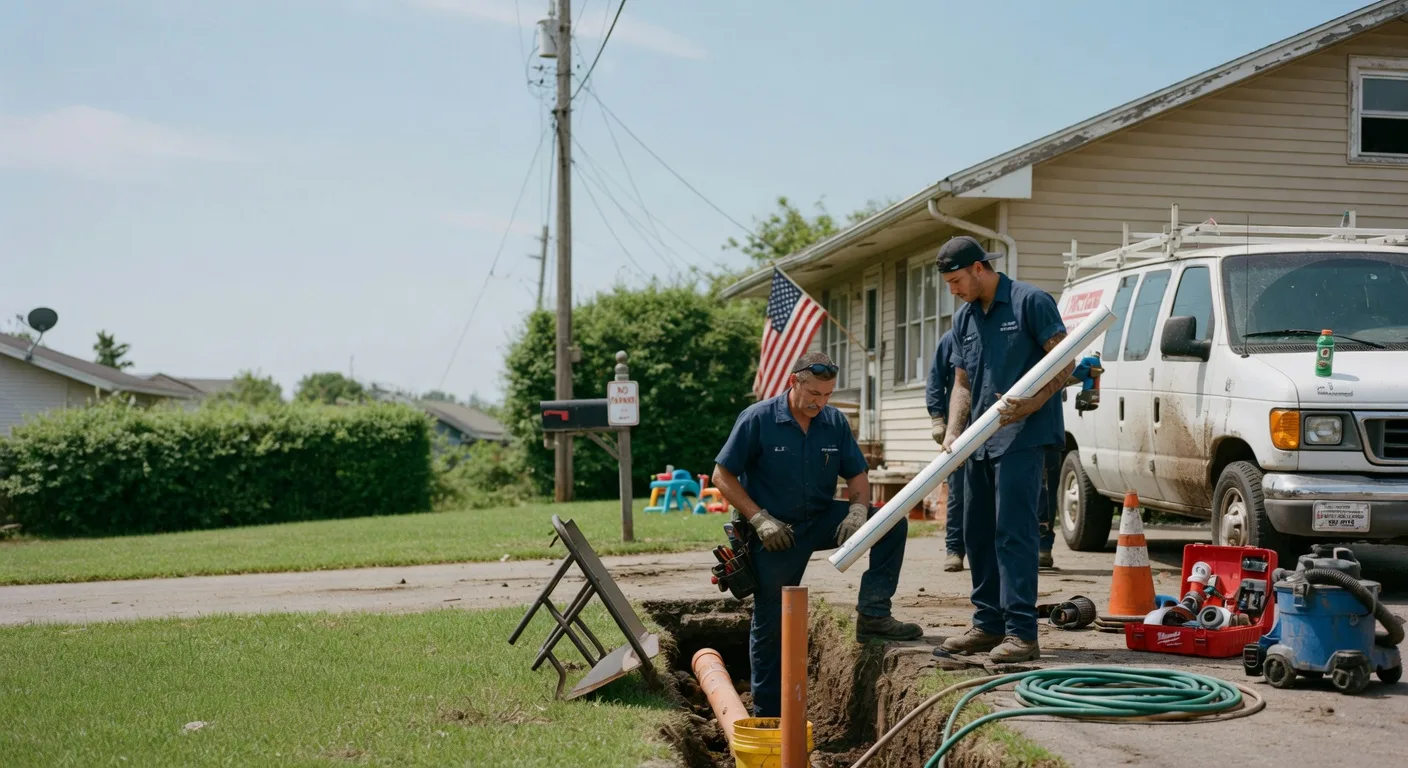
When is a drain backup a plumbing emergency?
Stop running water and call now if water is backing up from more than one drain, sewage is coming up through a floor drain or tub, a toilet overflows on its own, or you smell sewer gas inside the house. Those signs point to a blocked or failed main line. That is a different problem from one slow sink. The main line carries everything the house sends out, so when it stops, water has only one place to go, which is back up through the lowest opening in the house, usually a basement floor drain or a tub. Every load of laundry, dishwasher cycle, or shower adds to the flood, so turning off water use is the most useful thing you can do while you wait. Do not try to clear a full main line yourself; it takes a larger cable or a jetter, and sewage carries bacteria. Keep children and pets out of the affected area. A single slow drain that still empties, or a fixture that gurgles once in a while, can usually wait for a scheduled visit. A backup that is rising, spreading, or coming from several places cannot. Call (380) 262-9173 to be connected with an independent plumber in Seltzer, PA.
If you decide the situation is serious, a few quick actions will limit the damage. Shut off the washing machine and dishwasher, and ask everyone to hold off on flushing. If water is already on the floor, lift rugs and move belongings out of the way, and keep electrical items and cords clear of wet areas. Do not run a wet vacuum on sewage, and do not wade through it barefoot. Take photos of the water and the affected fixtures, since they help if you later need to describe the problem to an insurer. Open a window for ventilation if the smell is strong. Know where your main water shutoff is, because if a supply line is leaking rather than a drain backing up, that valve is the right one to close. Older homes often have a floor drain that is the first place sewage appears, so check it first.
Two houses share one sewer line. Whose blockage is it?
Your basement drain is backing up and the neighbor says theirs is fine. Or both are backing up and each blames the other. On a shared sewer lateral, that argument is common.
In older terraced or paired properties, two buildings join one lateral before it reaches the main. A blockage downstream of that junction backs up into whichever building sits lower. That is often not the building that caused it. Roots at a clay joint, grease build-up or a bellied line can sit past the junction and still flood one side.
One slow sink is local, and a cable machine usually clears it. Every drain in the building backing up points to the lateral. That calls for a camera inspection, and often hydro jetting.
A camera inspection and a locator establish where the junction is and where the blockage point sits. Distance readings matter: how far from the cleanout to the junction, and to the fault. They show which side of the junction the fault is on.
Responsibility depends on local rules and on where the fault sits. Some places treat the shared section as a joint matter for the owners, others place part of it with the utility. Do not assume. The city or sewer utility can say how it works for a given address.
Safe homeowner check: ask the neighbor if they have symptoms, and hold off on water use. Stop running water and call now if sewage is rising in a tub, shower or floor drain. What a repair involves depends on access, the materials, how much has to be opened up, and any permit or code requirement.
Expert Plumbers Co is a referral service. We refer homeowners in Seltzer, PA to an independent local plumber for Drain Cleaning and Emergency Drain Cleaning. Call (380) 262-9173.
Before anyone argues about cost, get the facts in hand. Agree with the neighbor to share the camera footage and the distance readings, so both households work from the same picture. Check the property records for any easement or shared-line agreement, since some older properties carry one. Ask the local building department or sewer utility who maintains the section between the junction and the main.
Ask your home insurer whether sewer backup is covered. Many policies treat it as an optional add-on, and a claim usually needs documents.
Once the line is clear, the sensible follow-up is a maintenance plan both sides accept. That might be periodic jetting, or a cleanout fitted at the junction so future blockages can be reached without digging. A cleanout in the right spot turns a future emergency into a short job. Keep the plumber's written findings. They settle most disputes about where the fault sat.
We live in a manufactured home. Why do the drains under the floor keep clogging?
You live in a manufactured home, and the drains keep clogging. A sink runs slow, the tub gurgles, or the toilet backs up every few months. The cause is usually under the floor, where you cannot see it.
Drain lines in a manufactured home run through the belly wrap, between the floor framing and the ground. The runs are long and shallow, with very little fall, so water and solids move slowly and grease, soap and paper settle. Over time the hangers that hold the pipe can fail and the line sags. A sagging section becomes a bellied line that holds water and collects debris. Lightweight plastic pipe can also crack or pull apart at joints when the ground shifts.
Cold weather adds a problem. Pipes under the floor can freeze, and a frozen drain looks like a clog until it thaws. Roots can also reach the outside section where the home ties into the sewer.
One slow fixture is usually a branch or trap problem near that fixture. If sinks, tub, toilet and washer all slow down together, or water comes up in the lowest fixture, the main run under the home or the sewer connection is the likely spot.
Safe homeowner check: Run each fixture one at a time and note which are slow. Look for a cleanout outside near the home and see whether it holds water, without opening it under pressure. Do not crawl under the home if it is wet or smells of sewage.
Stop running water and call now if sewage is coming up inside, if water drips from the belly wrap, if the floor feels soft, or if the smell of sewage is strong under or around the home.
A cable machine is often enough for a soft clog in one branch. Hydro jetting is the better tool for build-up on the wall of a long, shallow run. A camera inspection is the right step when clogs keep returning, because it can show a sag, a cracked joint or a separated pipe.
Expert Plumbers Co is a referral service. We connect you with an independent local plumber in Seltzer, PA. Call (380) 262-9173.
Ask the plumber how they will reach the pipe and whether the belly wrap has to be opened and resealed. The scope depends on access under the home, how much belly board or insulation comes off, the pipe material, whether hangers need replacing to restore the slope, and any permit or code requirement.
The plumber suggested a smoke test. What does that find that a camera does not?
Your plumber says "let's do a smoke test," and you wonder why, when a camera already looked in the pipe. The two tools answer different questions, and the smoke test finds things the camera cannot.
A drain camera travels down the inside of a line. It shows roots, grease, scale, a belly holding water, an offset joint or a crack in the section it can reach. But it can only go where the cable can push it. It cannot climb a vent stack in a wall, it tells you little about the vent side of the system.
A smoke test pushes non-toxic smoke through the drain and vent system under light pressure. Wherever the system is not sealed, the smoke shows itself. It can come out of a cracked vent pipe in the attic, a missing cleanout cap, a broken pipe inside a wall, or a dry trap. That explains symptoms a camera often misses: sewer smell with clean-looking drains, gurgling fixtures, and slow drains caused by a blocked or damaged vent.
One fixture that drains slowly is usually a local clog and rarely needs a smoke test. Sewer odor in several rooms, gurgling at more than one fixture, or a smell that has no clear source points at the system as a whole, and that is where the smoke test earns its place.
Safe homeowner check: pour water into every floor drain and rarely used sink so the traps are full, because a dry trap can mimic a leak.
Stop running water and call now if wastewater backs up in a tub, shower or floor drain, if the toilet will not clear, if you see wet floors or stained ceilings, or if the smell is strong enough to make anyone dizzy or sick. Leave the area and ventilate it first.
A cable machine is enough when the problem is a plain clog. If the smoke test shows a vent or pipe defect, the job becomes a repair, not a cleaning. If the line is coated with grease or scale, hydro jetting may be proposed. If the cause is still unclear, a camera inspection on the drain side often pairs well with the smoke test.
Expert Plumbers Co is a referral service. We connect you with an independent local plumber in Seltzer, PA. Call (380) 262-9173.
Ask the plumber what they are trying to confirm and where the smoke came out. Ask whether the vent, a wall section or the main line needs repair, and whether a camera pass should follow. The scope depends on access to the pipe, the parts or pipe needed, how much wall, ceiling or floor must be opened, and any permit or code requirement.
Our walk-in shower has a long linear drain and it keeps backing up. Why?
Your walk-in shower has that long, slim linear drain along one wall or the back edge, and it keeps backing up. The water rises around your feet, drains slowly, then does it again a week later. There are a few reasons a linear drain behaves this way.
The channel is long and shallow, so it collects hair and soap scum along its whole length. Many linear drains also have a small outlet at one end or in the middle, often undersized compared to the flow from a large shower head. If the pan is built with a low slope toward the drain, water crawls instead of running, which leaves scum behind and lets hair settle. Under the cover, the trap or the first section of pipe can also fill with hair, so the channel looks clean and still backs up.
If only the shower backs up and the sink and toilet in the same bathroom are fine, the problem is the channel, its outlet, the trap or the shower branch. If other fixtures are slow or gurgling, or water shows in a floor drain, the line further down is involved.
Safe homeowner check: lift out the grate or cover and clean the channel with gloves. Look at how water moves across the floor, because standing water on the pan suggests a slope problem rather than a clog alone. Skip chemical openers.
Stop running water and call now if sewage or gray water comes up elsewhere, if you see moisture on the ceiling or walls below the shower, if the floor around the shower feels soft, or if a sewer smell comes with the backups. A leaking pan is a different problem from a clog and can damage the structure.
A cable machine is usually enough for hair and soap in the trap or short branch, though the plumber must be able to get past the channel outlet. If the problem keeps coming back, a camera inspection can show a belly, offset or roots beyond the shower. Hydro jetting may be proposed when the pipe wall is coated with grease or scale.
Expert Plumbers Co is a referral service. We connect you with an independent local plumber in Seltzer, PA. Call (380) 262-9173.
Ask the plumber whether the cause is the drain body, the slope of the pan or the pipe beyond it. If the slope or outlet is the problem, ask what it takes to correct it. The scope depends on access to the drain, the parts or materials needed, how much tile or floor has to be opened up, and any permit or code requirement.